
Friday, May 15, 2026
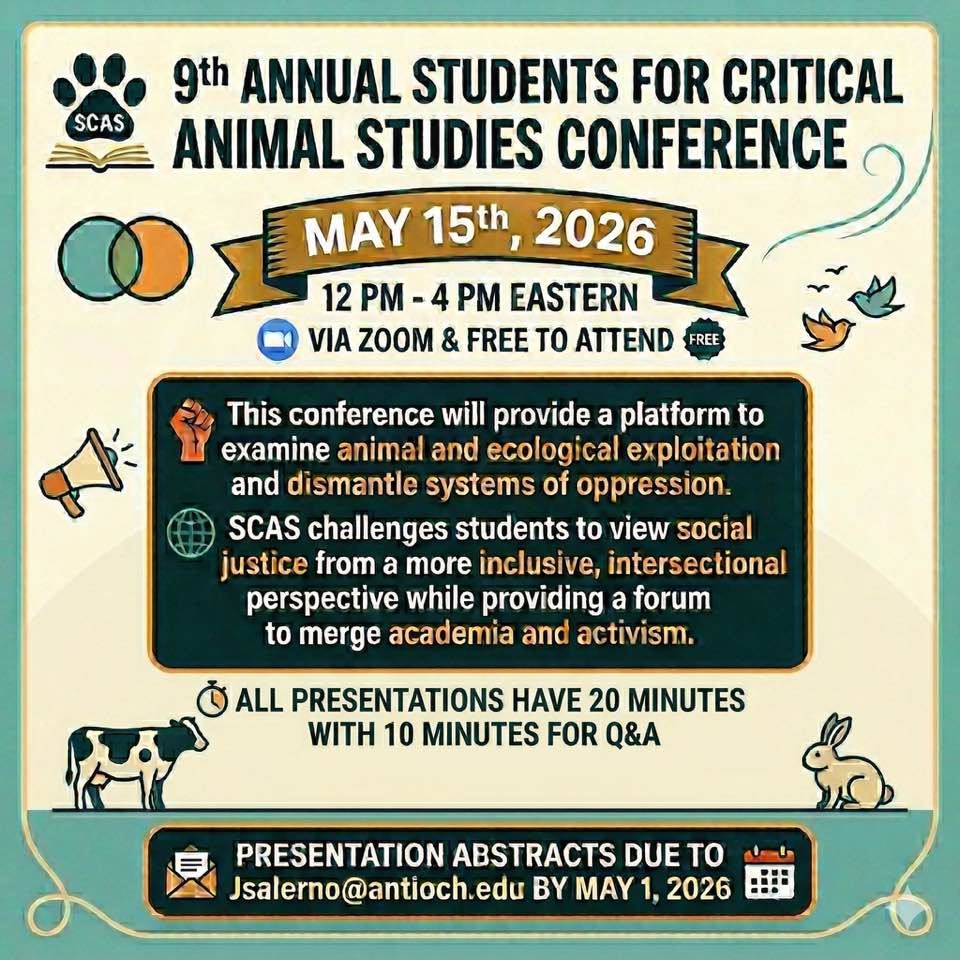
12:00pm to 4:00pm Eastern USA Time
9th Annual Students for Critical Animal Studies Conference
Family Friendly. Zoom. Free. Public.
Register Here:
https://us02web.zoom.us/meeting/register/x-cxhSJTTJ-r7I1S9xzpBg
Schedule
12:00pm to 12:25pm
Greeting
Presenter: Dr. Jennifer Salerno, Ed.D.
Description of SCAS: Founded in 2012 by Daniel Frank and Rockwell Schwartz at Vassar College, Students for Critical Animal Studies (SCAS) is an international association of students dedicated to the abolition of animal and ecological exploitation, oppression, and domination. SCAS challenges students to view social justice from a more inclusive and intersectional perspective, while providing a forum for the meeting of academia and activism. To this end, SCAS works with students to expand the presence of CAS programs and classes. SCAS hosts workshops, forums, conferences, protests, candle light vigils, and debates around the world. This group is open to all students from high schools to online colleges to graduate schools.
Biography: Dr. Jennifer Salerno is a scholar-activist with expertise in early childhood education whose work is rooted in transforming conceptions of ability and fostering interdependent relationships that include the natural world. Jennifer’s scholarship uses a transdisciplinary approach to challenge ableism, eco-ableism, and the oppression of nature. Through critical and transformative autoethnography, Jennifer employs narrative to explore how lived experience can challenge dominant onto-epistemologies, foreground diversity as a desirable asset, and situate disability as a catalyst for creativity and innovation.
12:30pm to 1:00pm
Presenter One: Aleksandra Musial
Title: Legal status of feral animals through the lens of critical animal studies
Abstract: Drawing on critical animal studies and the Marxist method, this presentation explains the legal situation of feral animals. It situates and describes the legal liminality of certain animals through this lens. Firstly, the normative situation of feral animals is explained, and instances are recalled in which the same species of animal functions in different relations to humans. Then, legal and political propositions on the postulated feral animals’ situation are discussed: animal denizens, potential fundamental rights holders. In the final step, Wischermann and Howell’s historical critical animal studies lens helps position feral animals against the metabolic rift. This presentation argues that to explain the precarious legal situation of feral animals, critical legal, political, and animal rights theories must be applied. This presentation proposes using methods of interpretation of feral animals’ actual legal situation, which contextualize their status. This interpretation leads to understanding all human-animal relationships as capital-centric and sees feral animals as resistance actors. The conclusion is reached that critical animal studies and Marxist critique enhance animal law’s scholarship and should be considered by animal law scholars when justifying their choice of theoretical framework.
Biography: Aleksandra Anna Musial earned a law magister’s degree and a bachelor’s degree in philosophy from the University of Warsaw. In Fribourg, Switzerland, she completed one of the years of law studies. Afterward, she worked for an international non-governmental organization in Bonn, Germany. In 2025, she started her L.L.M. in Transnational Law at the University of Bremen. She is currently employed at the Forschungsstelle für Tier- und Tierschutzrecht, a research institute focused on animal protection law and animal law, led by Prof. Dr. Sönke Florian Gerhold at the University of Bremen.
Q and A
1:30pm to 2:00pm
Presenter Two: Jennifer Peck, MFA, M.Ed.
Title: If It Is So Good, Why Is He Trembling? Animals and Disability Discourse in the Arts
Abstract: Poet Ashley Capps said that as a vegan working for liberation, she noticed that “in Western poetry at least, animals have disproportionately functioned as symbols and props, stand-ins for human emotion and predicament rather than subjects portrayed as fully dimensional beings or protagonists in their own right”. Additionally, in Lua Kozak’s “Fostering an inclusive multispecies social pedagogy: rethinking ethical human–animal relations in art”, Kozak questions the anthropocentric nature that human-animal relationships are depicted in art and literature. This paper explores the representation of animals as symbols in works of art like Wicked (from where the paper’s title comes from) and others. Author/artist Sunaura Taylor writes about similar depictions in art of both animals and disability and while those two movements can be at odds – see ‘Ableism and Specieism: Tensions and Convergence Between Animal Rights and Disability Rights’, a chapter in 2024’s The Plant-based and Vegan Handbook – this paper looks at how art and media depictions tend to ‘cage’ those that the mainstream is afraid of or doesn’t like. Tayor, in the book Beasts of Burden: Animal and Disability Liberation, reminds us that “the sideshow and the modern zoo both emerged in the nineteenth century” and poet Capp believes “How we write about animals, how they’re represented in our poems and stories, not only reflects how we relate to them in the larger world—it also shapes how we treat them. Thus, any shift in how we perceive and treat other animals necessarily involves a shift in how we read and write about them.” If art is responsible for mirroring how man thinks of himself and others, can it also change those beliefs for the better?
Biography: With a MFA in Creative Writing and a MEd in Learning, Design, Technology and Curriculum, Jenn Peck is currently working toward her EdD at Rowan University where her dissertation work focuses on integrating arts and humanities into medical education/veterinary medical education curriculum. She has a graduate certificate from the Institute of Humane Educator and currently works as an instruction designer at the Shreiber School of Veterinary Medicine at Rowan University. She teaches English comp and humanities classes as an adjunct at Philadelphia/NJ area colleges and universities and is the co-chair of rhetoric/composition at the Mid-Atlantic & American Popular Culture Association.
Q and A
2:00pm to 2:30pm
Presenter Three: Shelby Bobosky, Esq.
Title: Harvesting Harm: How New Texas AG Laws Fail Texans
Abstract: Texas’ recent “Right to Farm” amendment (Proposition 1) has fundamentally shifted the balance of power between industrial agricultural operations and local communities. While marketed as a protection for small-scale family farms, the amendment’s broad language elevates industrial operations above traditional property rights, health, and environmental standards. Marketed as a shield for Texas family farmers, but it has turned into a sword for industrial agriculture, undermining the property rights and safety of individual Texans. In other words, by creating broad, constitutional protections for massive agricultural operations, this new law effectively guts local health, safety, and environmental standards. This presentation will analyze how this constitutional change—paired with a broader legislative trend in Texas—creates a “blank check” for large-scale operations, overriding local oversight. The presentation will detail the legal consequences of this shift and the resulting risks to Texans’ health and land values.
Biography: Shelby attended the University of Kentucky for her undergraduate degree, earning a double major in History and Spanish in 1996. She then attended the University of Tulsa Law School and spent a year as a visiting law student at Northwestern University School of Law graduating in 1999. Shelby moved from Chicago to Dallas to begin her law practice and continued practicing general civil litigation for fifteen years when she decided to do only pro bono work putting in hundreds of hours in assisting animal welfare advocates and animal rescues when possible. From 2011 to 2026, Shelby served as a board member, board chair and legislative chair of the Texas Humane Legislation Network and then as the Executive Director. Under her leadership, she helped pass the following laws among others: the Anti- Gas Chamber law, the Mandatory Canine Encounter law, Strengthening the Animal Cruelty law, the Safe Outdoor Dogs Act and Strengthening the Texas Dog or Cat Licensed Breeder Act. Shelby was heavily involved in the Dallas Association of Young Lawyers, co-chairing the Animal Welfare Committee for four years and raising thousands of dollars for local 501(c)(3) rescues during her terms. Shelby currently serves as an AdjunctLegal Professor at the SMU Dedman School of Law and she teaches Animal Law in the Fall (eight years) and Wildlife Law in the Spring (five years). She has presented courses on animal cruelty, the LINK between animal cruelty and interpersonal violence and Texas Animal Laws to judges, lawyers, animal cruelty investigators,LEOS and ACOs. She and her husband, three boys, rescue dogs and fosters live in Dallas, Texas.
Q and A
2:30pm to 3:00pm
Presenter Four: Kelly Nix
Title: What Kids Ask at Sanctuaries That Adults Often Don’t: Exploring Social Conditioning, Compassion, and Humane Education Through Sanctuary Encounters
Abstract: This presentation explores the differing ways children and adults engage with rescued farmed animals in sanctuary spaces. Drawing from years of humane education and public interaction at a farmed animal sanctuary, this talk examines recurring patterns in the questions children ask compared to those posed by adults. Children frequently center emotion, fairness, individuality, and relationships in their inquiries, while adults more often approach animals through categorization, rationalization, or systems-based thinking. Using perspectives from humane education, developmental psychology, critical pedagogy, and socialization theory, this presentation considers how cultural conditioning shapes moral boundaries and influences human-animal relationships over time. Particular attention will be given to the role of language, normalization, and institutional messaging in teaching individuals which forms of violence are socially acceptable and which beings are considered worthy of empathy. The presentation further positions sanctuary spaces as sites of experiential and transformative learning capable of disrupting dominant narratives about farmed animals. Through storytelling, reflection, and direct encounter, sanctuaries create opportunities for ethical inquiry and emotional reconnection that are often absent in traditional educational environments. Ultimately, this presentation asks what might be learned from the openness, curiosity, and relational thinking children often bring into sanctuary spaces, and what these encounters reveal about the social construction of compassion itself.
Biography: Kelly Nix is an educator and advocate whose scholarship and activism span human rights, animal welfare, and environmental justice. With over a decade of experience in education and school leadership, she serves as the Executive Director of Luvin Arms Animal Sanctuary in Colorado. This organization centers education as the primary catalyst for creating a more compassionate and just world. As a board member of the Brave New Life Project, Kelly highlights the hidden human impacts of animal agriculture, advocating for a holistic approach to liberation that addresses intertwined systems of oppression. Her dissertation introduces “The Web of Liberation,” a transdisciplinary framework mapping interconnected oppressions such as racism, speciesism, ableism, patriarchy, and ecological destruction. This model emphasizes coalition-building across movements and advocates holistic justice approaches to encourage integrated solutions in education, activism, and policy. Her academic background includes a B.A. in Sociology, a Master’s degree in Special Education and Educational Leadership, and she is currently pursuing a Doctorate in Educational & Professional Practice with a focus on Comprehensive Humane Education. She will begin the Animal Law MSL Program through Lewis & Clark Law School in Fall 2025. Beyond her advocacy, Kelly enjoys the surprisingly calming and meditative experience of vacuuming, finding peace in the satisfying sounds of cleaning.
Q and A
3:00pm to 3:30pm
Presenter Five:
Title:
Abstract:
Biography:
Q and A
3:30pm to 4:00pm
Presenter Six:
Title:
Abstract:
Biography:
Q and A
4:00pm
End of the Conference