
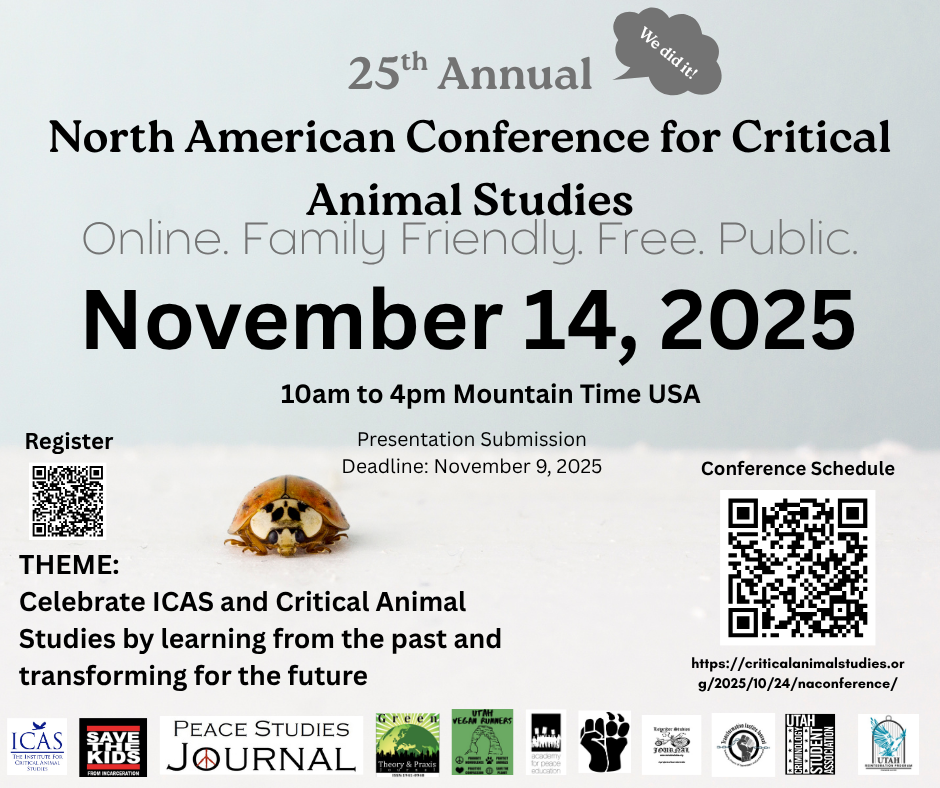
25th Annual North American Conference for Critical Animal Studies
Friday, November 14, 2025
9:00am to 3:30pm Western Time USA
10:00am to 4:30pm Mountain Time USA
11:am to 5:30pm Central Time USA
12:00pm to 6:30pm Eastern Time Usa
Click Here To Register:
https://slcc-edu.zoom.us/meeting/register/oChDH4rbRQm8tODNgLzX_g
Free. Public. Family Friendly. Recorded.
Chairs:
Jen Salerno, Anthony J. Nocella II, and Laura Schleifer
CONFERENCE SCHEDULE
Welcome and Opening Remarks – 10:00am
Jen Salerno & Laura Schleifer
Biography: Jennifer Salerno is an early childhood educator and child advocate based in Baltimore, Maryland. Grounded in critical pedagogy, her work attempts to disrupt dominant ideologies and foster critical thinking, collective empowerment, and social transformation. Jennifer’s educational practice employs an emergent pedagogy that aims to reimagine ability, community, and interdependence with the natural world. As a doctoral candidate at Antioch University, Jennifer utilizes a transdisciplinary framework—drawing on ecoability, posthumanism, and transformative learning theory—to challenge normative notions of ability and independence. Her research strives to advance an ethic of interdependence that recognizes the entangled relationships between human and more-than-human beings in the pursuit of social, disability, and environmental justice.
Biography: Laura Schleifer is a lifelong ‘artivist’, or artist-activist. An NYU Tisch graduate (BFA, Drama), she’s toured the Middle East, performing for Palestinian and Iraqi refugee children with the Boomchucka theater/circus troupe, taught in China, Nicaragua, and at Wesleyan University’s Green Street Arts Center, performed off-Broadway, and arts-mentored NYC homeless/targeted youth. Her original screenplay, The Feral Child, was a Sundance Screenwriter’s Lab finalist. Her essays appear in New Politics Magazine, The Leftist Review, Forca Vegan, The New Engagement, and multiple anthologies, including Kropotkin Now! Life, Freedom and Ethics, published by Black Rose Books, Resisting Neoliberal Schooling; Dismantling the Rubricization and Corporatization of Higher Education and Expanding the Critical Animal Studies Imagination; Essays in Solidarity and Total Liberation both published by Peter Lang Publishing, and Fever Spores; William S. Burroughs and Queer Letters, published by Rebel Satori Press. Laura is also Program Chair at Promoting Enduring Peace (https://pepeace.org/), a historic U.S. peace organization, and co-founder of Plant the Land (www.planttheland.org) , a Palestinian-led vegan food justice/community projects mutual aid team in Gaza.
Presenter One – 10:30am
Title: Recognizing Non-Human Animals as Sentient Beings
Presenter: Billie Groom
Abstract: This presentation introduces the concept of “sentientism”, a movement dedicated to promoting evidence, reason and compassion to encourage respect for all living beings as individuals deserved of the “Five Freedoms”. By exploring topics such as cognition, emotion, self-regulation, mindfulness, decision-making, autonomy, agency and intrinsic motivation, this presentation develops a deeper understanding of the emotional needs of animals, their innate survival skills, and their inherent intellectual capacity. Although, sentientism refers to all species, the examples focus on domestic pets, making them easily relatable to participants of all ages. The examples highlight real-life situations depicting everyday activities where dogs employ cognitive skills. Maturation, perception, and cognition are discussed on a basic level to elevate our understanding of the impact of these concepts on emotions and behavior. The purpose of the talk is to inspire ethical curiosity to explore the influence of our beliefs and, thus, our actions on our surroundings, locally and globally. By heightening our understanding of the physical, emotional and intellectual needs of non-human animals, we begin to recognize our role and responsibility as humans in developing and sustaining a balanced ecosystem.
Biography: Billie Groom is a member of the Canadian Psychological Association, a TEDX Speaker, award-winning author and podcast host, and founder of Sentientism Canda. She is a guest lecturer at Hartpury University and has spoken at numerous conferences including the PHAIR and International Anthrozoology Conferences (2025) as well as a featured on many media platforms, including Psychology Today Magazine and Roku TV. Billie completed the PhD program, Cognition and Emotion to Improve Animal Welfare, and is currently completing her PhD in Transformational Ecology. Billie is the founder of the Institute of Canine Psychotherapy.
Presenter Two – 11:00am
Title: Animal Activists as Humane Educators: Cultivating Critical Thinking and Compassionate Action
Presenter: Emily Tronetti
Abstract: Animal activists are, in many ways, humane educators, whether or not we consciously identify as such. By challenging others to reflect on the ways humans impact other animals, we inherently engage in educational work, promoting both individual and systemic change. For activists, this work can take many forms, including awareness campaigns, one-on-one conversations, or modeling less harmful ways of living. Yet, like any educator, we can strengthen our impact by intentionally developing our skills and practices. This interactive session will center on how activists can integrate comprehensive humane education into their work. Comprehensive humane education is a field of study and practice that brings awareness to the interconnected issues affecting humans, other animals, and ecosystems. We’ll explore how humane education can counter oppressive practices by cultivating critical thinking and fostering empathy. Participants will learn practical strategies for guiding others to recognize their biases, question normative practices, and take compassionate action. By embracing our roles as humane educators, we can create transformative learning experiences, build meaningful connections, and inspire lasting change. Attendees will leave with concrete tools for integrating humane education into their advocacy, alongside a framework for understanding activism as an ongoing educational practice.
Biography: Emily Tronetti, EdD (she/her) is the Community Connection Specialist for the Humane Education Graduate Programs at the Institute for Humane Education. She earned her Ed.D. in Educational and Professional Practice with a specialization in Humane Education from Antioch University and IHE. In addition to her work at IHE, she is an adjunct professor for Canisius University’s graduate program in anthrozoology. At the heart of Emily’s transdisciplinary work is a commitment to cultivating multispecies communities grounded in justice, care, and mutual flourishing.
Presenter Three – 11:30am
Title: Invisibilization of Animal Journalism: Ideological Gatekeeping, Soft Censorship, and Marginalization of Anti-Speciesist Journalists in Spanish Written Media
Presenter: María Ruiz Carreras
Abstract: This presentation examines the dual marginalization present in the Spanish media: the invisibility of nonhuman animals as agents and the systemic obstacles faced by journalists attempting to represent their interests. Through in-depth interviews with Spanish journalists engaged in anti-speciesist reporting, the study investigates the persistent marginalization of anti-speciesist journalism and the challenges of advocating for nonhuman animal rights in written media newsrooms. Findings reveal that journalistic conventions, ideological biases, and structural constraints contribute to the framing of nonhuman animals as passive commodities, while their agency and individuality are overlooked. Journalists covering animal rights encounter editorial resistance, with their work frequently dismissed as trivial or non-serious. These barriers manifest through ideological gatekeeping, soft censorship, and the demand for “balance” that privileges speciesist perspectives. Situated within critical animal media studies and gatekeeping theory, the research contextualizes the marginalization of anti-speciesist perspectives within broader patterns of media exclusion. It highlights tensions between journalistic integrity and human-centric media priorities, emphasizing the need for structural changes to ensure nonhuman animal rights receive sustained attention in the Spanish press.
Biography: María Ruiz Carreras is a communications scholar and researcher with 20 years of professional experience spanning journalism and communication strategy. She is currently a postdoctoral researcher at University College Cork (Ireland) on the Creative-C Change project in the School of Engineering and Architecture, Sustainability Department. Previously, she lectured and conducted research at Lund University and Halmstad University in Sweden. A member of the Lund University Critical Animal Studies Network (LUCASN) and EACAS, her work explores strategic communication, political economy, critical animal studies, public relations, public affairs, sustainability, and intersectionality. She holds a PhD in Communication from Pompeu Fabra University (Spain), two Master’s degrees, and degrees in Advertising & Public Relations and Graphic Design from institutions in Spain and Belgium.
Presenter Four – 12:00pm
Title: Building a Movement Through Motion
Presenter: York Hayes
Abstract: This presentation will be an informal personal ethnography describing the development, engagement, reflection, skills, and strategy in building a vegan running community internationally. Vegan running is an international movement growing strongly within the area of trail running for the last ten plus years, specifically in Ragnars. York will discuss how he went vegan and how he was introduced to his first vegan running group.
Biography: York Hayes works professionally as a sales consultant in the solar and home energy efficiency industries. He has worked in direct sales for the past 25 years and brings his sales skills into his work with animal rights.
Presenter Five – 12:30pm
Title:Extinction as Care: Contradictions of Ableism, Anthroparchy, and Care
in Community Cat Caregiving in Los Angeles
Presenter: Katja M. Guenther
Abstract: This paper analyzes how caregivers for community (aka feral) cats in the Los Angeles area utilize suffering as an explanation for envisioning extinction as one desired outcome the caregivers hold for these cats. Analysis of data from interviews with 32 community (aka feral) cat caregivers reveals that although these caregivers see the cats as rightful members of the place and landscape of human-defined neighborhoods, many caregivers imagine the cats into non-existence rather than hoping for them to have a future as feral residents of the city. The wish for their disappearance from the city lies in their deep concern for the cats’ suffering, which the paper situates within broader dominant cultural discourses of disability. Analyzing community caregivers’ wishes for the extinction of community cats through feminist and ecoability frameworks illuminates how “extinction fantasies” rest on ableist and anthroparchic logics, even as caregivers act from feelings of love and care for these cats. The presentation opens with brief background into the current conditions facing community cats in the Los Angeles metropolitan area and the fieldwork. The analysis then examines the narratives of suffering community cat caregivers use in talking about the lived experiences of these cats, illuminating the contradictions they express between supporting cat colonies and hoping for them to cease to exist. Drawing on disability justice frameworks and the concept of anthroparchy reveals how the extinction fantasies of community caregivers rest on dominant cultural assumptions about what kinds of animal lives are worth living and on the premise that humans are ultimately those who are responsible for deciding the fates of animals.
Biography: Katja M. Guenther is Professor of Gender and Sexuality Studies at the University of California, Riverside, whose research, teaching, and activism center on addressing why inequalities of gender, race, class, dis/ability, and species reproduce so reliably, and what we can do to challenge them. She is the author of The Lives and Deaths of Animal Shelters and Making Their Place: Feminism after Socialism in Eastern Germany and co-editor of When Animals Die:Examining Justifications and Envisioning Justice. More information is available at www.katjamguenther.com.
Presenter Six – 1:00pm
Title: The Plant Based Treaty Campaign in Canada
Presenter: Varun Virlan
Abstract: The Plant Based Treaty and its 3R framework of Redirect, Relinquish, and Restore, alongside 40 actionable proposals to align our food system with the Paris Agreement, aim to transform food systems globally by promoting plant-based diets, reducing the environmental footprint of food production, and restoring degraded ecosystems. Brampton serves as an inspiring example of municipal leadership. The city’s endorsement of the Plant Based Treaty includes a commitment to developing a comprehensive plant-based food strategy. Key initiatives include featuring environmentally friendly plant-based food options at city council meetings and events, requiring at least 50% of catering at open-space events to be plant-based, and exploring plant-based defaults in city facilities and regional events. Brampton is also promoting a plant-based awareness week to educate residents about sustainable food practices and will report on progress in six months as part of its action plan. Through case studies like Brampton, I will showcase how the Plant Based Treaty can drive meaningful change. By implementing all 40 proposals, cities and nations can work toward a sustainable, Paris-aligned food system that prioritizes environmental restoration, public health, and animal protection.
Bio: Varun Virlan is a Toronto-based animal rights advocate who became vegan 11 years ago after learning about the horrors of India’s dairy industry, falsely portrayed as ethical and rooted in reverence for cows. Varun serves as the Digital Media Director for the Plant Based Treaty. With a bachelor’s degree in Journalism and postgraduate certifications in Public Relations – Corporate Communications and Marketing Management, he combines his expertise with activism. Varun uses digital media to inspire compassionate, sustainable practices worldwide.
Presenter Seven – 1:30pm
Title: Youth activism, anti-fascism, and vegan snack cakes: The History of The Raven Corps
Presenter: Claire Howe
Abstract: Claire will discuss her work as the founder and executive director of The Raven Corps, a total liberation youth activist organization, and why the mainstream Vegan movement desperately needs its own revolution.
Biography: Claire Howe (she/her) is a long-time activist, animal rights attorney, humane educator, and founder of The Raven Corps, Vegans Against Fascism, and co-owner of Cool Kids Snack Cakes.
Presenter Eight – 2:00pm
Title: Decapitating the Lawn: Vegetal Suffering and the Discipline of Green Life in Critical Animal Studies with Kristeva, Bloch, and Bataille”
Presenter: Lukas Dietsche
Abstract: This paper argues that lawn mowing, often perceived as a routine act of suburban maintenance, is instead a violent disciplinary practice that animalizes, regulates, and mutilates vegetal life. Drawing from his poem Ghost Rest Cemetery (Alan 2024), he reads the cutting of grass alongside Dante’s Inferno (Canto XIII), where the suicides become thorned, suffering trees endlessly wounded by harpies. In both Dante’s forest and the contemporary lawn, unruly growth is transformed into a site of abjection—severed, controlled, and denied its inherent potentiality. Through a Critical Animal Studies lens, the lawn emerges as a biopolitical surface where vegetal bodies are treated as expendable, governed by the same logics of domination applied to animalized beings. Integrating Ernst Bloch’s “not-yet,” Georges Bataille’s sacrificial expenditure, and Julia Kristeva’s aesthetics of decapitation, the paper conceptualizes mowing as a foreclosure of vegetal futurity. I introduce tracetenance—a fusion of trace and maintenance—to describe how scattered clippings and residual fragments function as both evidence of violence and carriers of latent possibility. By situating mowing within broader structures of control and exploring schizotypal poetics as an alternative ecological perception, the paper calls for reimagining the lawn as a wounded terrain whose suppressed vitality demands ethical and political attention.
Biography: Lucas Alan Dietsche is the National Organizer of Letters to Prisoners-Save the Kids, a prison education professor, and editor of Poetry Behind the Walls. As the current Poet Laureate of Taconite Harbor, he has written and published many collections of poetry and novels. He has a Patreon account called The Pilot of Oumuamua. (pronouns: He, Comrade ) A PhD Student of the Institute for Doctoral Studies of Visual Arts with a master’s in criminal justice from University of Wisconsin, Dietsche is also an adjunct professor of Prison Education and has published on Poetic Inquiry Criminology, carceral feminism and tourism, and transformative justice.
Presenter Nine – 2:30pm
Title: Following Abundance’s Lead!
Presenter: Abundia Tristan Alvarado
Abstract: The Autonomous Kitchen Council (AKC) is a decolonial organizing framework focused on the creation of collectivist culture and praxis-oriented methodologies put forward by indigenous, stateless, and migrant, queer/trans comrades. It will be four years old on January 26, 2026! It has been a wild, incredibly eventful, difficult, and ultimately humble experience for all involved in the creation, development, and consolidation of this praxis oriented framework for care and revolution, but we have finally broken soil, and our mycelium is start to grow! We are now an incipient global network of baby AKCs sharing the same principles and working on local, regional, and inter-regional “Webbing”(our preferred word for Networking). New AKCs are being born in Europe and the Americas. AKC members are collaboratively utilizing the network’s infrastructure to develop educational tools designed to support communities seeking to organize within this framework. Additionally, workshops on our framework, including guidance on establishing an AKC and connecting to our mycelium network, are actively engaging all regions of Turtle Island this December. Efforts to also host an international AKC gathering in Puebla, Mexico in early Summer 2026 by Mexican comrades are underway! We have learned so much from our Webs of Abundance, particularly from our wise non-human comrades from many other species!
Biography: Abundia Alvarado (she/her) is a Nahuatl-Apache 2S Trans femme migrant from the Mexican desert lands. She is a community organizer advocating for food autonomy, indigenous rights, non human animals & qtgnc rights, and more. She is currently working on promoting the Autonomous Kitchen Council (AKC), a decolonial praxis oriented framework for creating systemic care, harnessing direct power, and shaping a revolution. She is focusing on consolidating the incipient network of Global AKC in Europe and the Americas and supporting groups adopting this framework. She is particularly interested in the potential of Abundance as an emergent revolutionary idea to generate ongoing processes of collectivity and with that infuse a new strength and praxis around organizing, care, resources, spaces, and revolution worldwide. She is also part of the movement, Stop Cop Cities in the so-called USA.
Presenter Ten – 3:00pm
Title: Fighting Racism While Fighting Cockfighting; Preserving human rights while helping Cockfighting Survivors
Presenter: Quincy Markowitz
Abstract: Quincy’s presentation will be about animal fighting – specifically cockfighting – and the ways the sanctuary community contributes to animal abuse being racialized. American rescuers often work with law enforcement to enact unjust and unequal punishment for cockfighters based on their race. Quincy first worked on a cockfighting bust in 2015 and saw with her own eyes the landowner – a rich, white farmer – escape any kind of punishment while ICE was sent in to deport the undocumented farm workers. In a time of mass deportation and rising fascism, it is as important as ever to separate carceral punishment from the idea of justice. The state uses the lives of birds – the very birds they eat and couldn’t care less about – to further its violent agenda. Quincy’s sanctuary sued a town to end a “chicken toss” event in white, rural Wisconsin and can speak to the abuse of animals we can address without further marginalizing oppressed humans. While Quincy currently has rescued birds from cockfighting and has worked in some capacity on multiple busts, she refuses to give law enforcement information that could be used to prosecute people of color.
Biography: Quincy co-founded Farm Bird Sanctuary in 2016. Quincy began working for sanctuaries in 2011 and created her own major at UW-Madison in animal welfare (with a focus on ornithology) graduating in 2015. Quincy not only feels passionately about birds, but sees the lack of advocacy for them as individuals even in the animal rights movement. Farm Bird Sanctuary focuses on birds with disabilities and is currently home to over 40 birds including two birds with amputated legs, two birds with amputated wings, six blind birds, and other various needs.
Presenter Eleven – 3:30pm
Title: Legal Protection of Animals and Activists
Presenter: Doris Lin
Abstract: Attorney Doris Lin discusses legal cases protecting animals and animal activists in New Jersey. Cases include challenging the state bear hunt, defending activists engaged in peaceful civil disobedience, and First Amendment protest rights.
Biography: Doris Lin is the Legal Director for the Animal Protection league of New Jersey and for the League of Humane Voters Of New Jersey. She is a former chair of the NJ State Bar Association’s animal welfare committee. She earned her bachelors degree in applied biological sciences from the Massachusetts Institute of Technology, before getting her JD from the University of Southern California. She is also the author of the wildlife protection chapter of the New Jersey Environmental Law Handbook.
Presenter Twelve – 4:00pm
Title: Introducing Children To Respectful Relations with All Life
Presenter: Jen Salerno
Abstract: This presentation explores approaches to introducing children to the more-than-human world in ways that decenter human dominance and cultivate an ethic of interdependence. Rooted in ecological thinking and a liberatory pedagogy, the session emphasizes shifting from a human-centered worldview, where humans are positioned hierarchically above all other beings, to one that recognizes children as participants in complex ecological relationships. By beginning with simple practices of noticing, children learn to attune to the presence of non-human entities such as plants, insects, soil, water, and animals, and to understand them as active contributors to shared environments rather than background scenery. Through the practice of learning with other entities, storytelling, and collaborative inquiry, children explore the roles these life forms play within ecosystems and consider how their own actions affect, and are affected by, these relationships. The presentation illuminates how educators can honor different ways of knowing and being predicated on respect, empathy, curiosity, and responsibility, while fostering interdependent relationships within diverse communities. Ultimately, this session emphasizes that fostering early relationships with non-human life not only nurtures a sense of ecological connectedness but also encourages children to see themselves as part of a larger, interconnected web of life, one in which all beings hold intrinsic value and contribute to collective flourishing.
Biography: Jennifer Salerno is an early childhood educator and child advocate based in Baltimore, Maryland. Grounded in critical pedagogy, her work attempts to disrupt dominant ideologies and foster critical thinking, collective empowerment, and social transformation. Jennifer’s educational practice employs an emergent pedagogy that aims to reimagine ability, community, and interdependence with the natural world. As a doctoral candidate at Antioch University, Jennifer utilizes a transdisciplinary framework—drawing on ecoability, posthumanism, and transformative learning theory—to challenge normative notions of ability and independence. Her research strives to advance an ethic of interdependence that recognizes the entangled relationships between human and more-than-human beings in the pursuit of social, disability, and environmental justice.
End of Conference: 4:30pm Mountain Time USA
Call for Speakers
All Speakers have 20 minutes to present with 10 minutes of questions and comments.
SUBMIT
All submissions for the conference need to hold to the mission and principles of CAS and ICAS and to submit in a Word Doc. as an attachment in an E-mail with the following information:
1. Title of Presentation
2. Biography third person 80 to 100 words one paragraph
3. Description/Abstract of the presentation around 200 words third person and one paragraph
4. Please make sure your presentation is family friend as we want to welcome all ages to learn.
DEADLINE EXTENDED:
November 11, 2025
SEND SUBMISSION TO:
hamella2@gmail.com
INTERESTED THEMES:
Transformative Justice
Critical disability studies
Healing Justice
Cultural and Religious intersectionalities
Language Terminology
Policy and/or/versus Culture Social Change
Social and Cultural Construction of Disabilities
Fighting Political and Corporate Repression
Being a Scholar-Activist
Decolonizing Movements and Education
Social Movement
Environmental Justice
Ecology
Social Ecology
Deep Ecology
Disability Pedagogy
Rhetoric of Health and Wellness
Social Attitudes of Neuroatypicality
Total Liberation
Anti-Capitalism
Racial Justice
Economic Justice
Social Justice
Youth Justice
Critical Eco-Feminism
LGBTTQQIA+ Justice
Mediation
Community Justice and Circles
Direct Democracy
Anarchist Criminology
Radical Criminology
Peace Studies and Making
Conflict Transformation and Resolution