
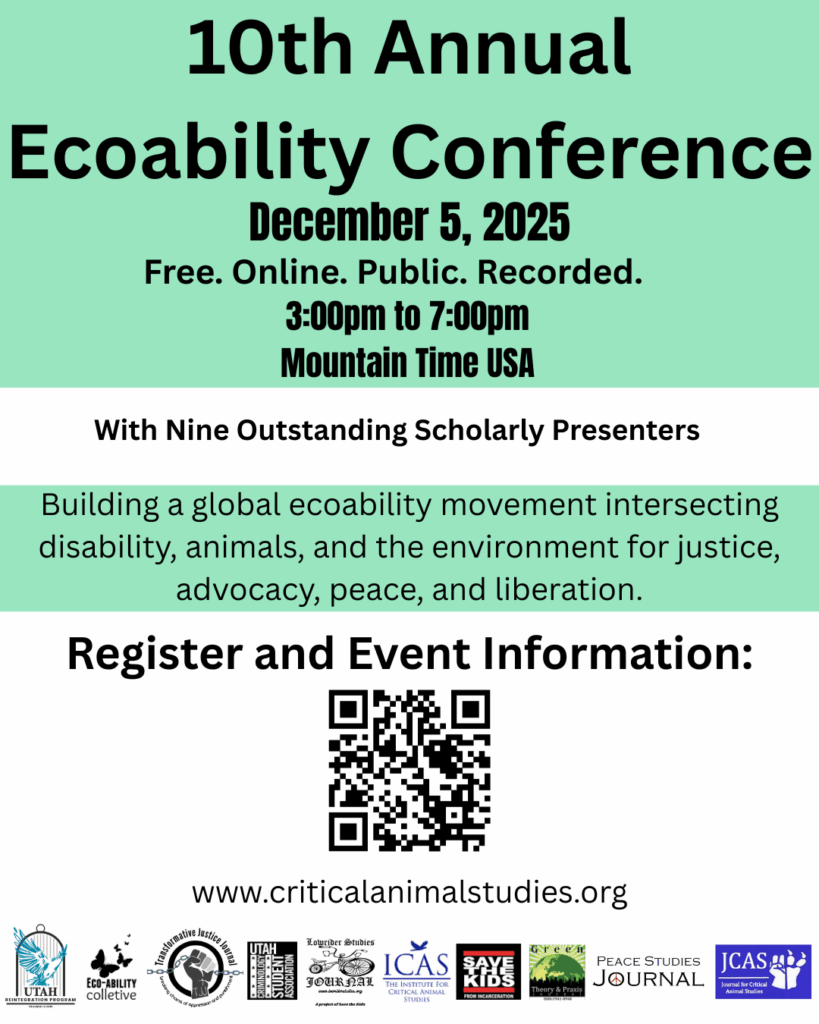
December 5, 2025
10th Annual Ecoability Conference
Building a global ecoability movement intersecting disability, animals, and the environment for justice, advocacy, peace, and liberation.
Family Friendly – Zoom – Free – Public
Register Here:
https://slcc-edu.zoom.us/meeting/register/CXg3z_NvQeWhIFBbLqoIBA
Co-Chairs:
Laura Schleifer, Jen Salerno, and Anthony J. Nocella II
SCHEDULE
2pm Western time USA to 6pm Western time USA
3pm Mountain time USA to 7pm Mountain time USA (Scheduled based on this time)
4pm Central time USA to 8pm Central time USA
5pm Eastern time USA to 9pm Eastern time USA
Introduction and Welcoming Remarks – 3:00pm
Jennifer Salerno and and Laura Schleifer
Biography: Jennifer Salerno is an early childhood educator and child advocate based in Baltimore, Maryland. Grounded in critical pedagogy, her work attempts to disrupt dominant ideologies and foster critical thinking, collective empowerment, and social transformation. Jennifer’s educational practice employs an emergent pedagogy that aims to reimagine ability, community, and interdependence with the natural world. As a doctoral candidate at Antioch University, Jennifer utilizes a transdisciplinary framework—drawing on ecoability, posthumanism, and transformative learning theory—to challenge normative notions of ability and independence. Her research strives to advance an ethic of interdependence that recognizes the entangled relationships between human and more-than-human beings in the pursuit of social, disability, and environmental justice.
Biography: Laura Schleifer is a lifelong ‘artivist’, or artist-activist. An NYU Tisch graduate (BFA, Drama), she’s toured the Middle East, performing for Palestinian and Iraqi refugee children with the Boomchucka theater/circus troupe, taught in China, Nicaragua, and at Wesleyan University’s Green Street Arts Center, performed off-Broadway, and arts-mentored NYC homeless/targeted youth. Her original screenplay, The Feral Child, was a Sundance Screenwriter’s Lab finalist. Her essays appear in New Politics Magazine, The Leftist Review, Forca Vegan, The New Engagement, and multiple anthologies, including Kropotkin Now! Life, Freedom and Ethics, published by Black Rose Books, Resisting Neoliberal Schooling; Dismantling the Rubricization and Corporatization of Higher Education and Expanding the Critical Animal Studies Imagination; Essays in Solidarity and Total Liberation both published by Peter Lang Publishing, and Fever Spores; William S. Burroughs and Queer Letters, published by Rebel Satori Press. Laura is also Program Chair at Promoting Enduring Peace (https://pepeace.org/), a historic U.S. peace organization, and co-founder of Plant the Land (www.planttheland.org) , a Palestinian-led vegan food justice/community projects mutual aid team in Gaza.
Presenter One- 3pm
Title: Climate & Disability: Inequities, Ableism, and Paths Forward
Presenter: Sam Beleutz
Abstract: People with disabilities (PWDs) are disproportionately impacted by the climate crisis, yet are often excluded from climate conversations, policies, and planning. Despite this, the environmentalist movement has largely ignored or sidelined disability justice, reinforcing systemic ableism under the guise of sustainability or urgency. This high-level presentation will cover a conceptual framework to understand the climate-disability puzzle, shed light on the many faces of eco-ableism, and identify opportunities to develop truly inclusive, accessible adaptation and mitigation. It will break down the components of both climate and disability, demonstrate the nature of the connections between them, and impart how to identify and tackle these broad and nuanced topics. Based on insights from researchers across the globe, it will then explore how ableism persists within mainstream environmentalist discourse. And finally, it will present some high-level strategies and focus areas for cohesive climate and disability justice through anti-oppressive grassroots action and systems change. This talk calls on attendees to not only recognize PWDs as a frontline community but also as vital leaders in climate justice.
Bio: Samantha Beleutz is a dedicated climate justice advocate based in Toronto, Canada, with a B.Sc. in Natural Resources Conservation from the University of British Columbia. Her expertise lies in environmental equity analysis and interdisciplinary research, which she uses to promote systemic change for all oppressed beings. Alongside Accessible Climate Strategies founder, Alex Ghenis, she works to equip organizations with climate resilience strategies that are truly inclusive and reflect the needs and rights of People with Disabilities. Living with lifelong chronic illnesses affecting mobility and vision, she leverages her personal and professional experiences to help implement equitable solutions to complex climate challenges.
Presenter Two – 3:30pm
Title: Tracetenance of the Cut: Schizotypal Poetics, Eco-Abilities, and the Lawn’s Utopian Not-Yet Through Bataille, and Kristeva
Presenter: Lukas Dietsche
Abstract: Lawn mowing, far from being a neutral act of maintenance, constitutes a violent aesthetic and disciplinary practice where non-orthodox Marxist Ernst Bloch’s “not-yet,” Georges Bataille’s sacrificial expenditure, and Julia Kristeva’s aesthetics of decapitation converge to reveal the ordinary lawn as a theater of suppressed vitality. Part I discussed lawn mowing as a violent disciplinary practice within the field of Critical Animal Studies, revealing the lawn as a site where vegetal life is animalized, regulated, and mutilated under the guise of suburban order. Part Two turns toward Eco-Abilities, showing how schizotypal poetics and tracetenance reframe uncut grass, wild growth, and vegetal excess as forms of disabled ecological agency that resist normative control and open onto more inclusive environmental futures. This paper is also auto-ethnographical, with me being diagnosed with Schizotypal Personality Disorder a-clinically marked as rare, and pathologized through its magical thinking and eccentric relations to reality. Schizotypal is perpetual imagination and resonates uncannily with what Bloch calls the Not-Yet: a mode of thought oriented toward possibilities, correspondences, and futurities have not-yet arrived (Bloch, 1986 ). Along with author Georges Bataille’s The Sacred Conspiracy fascination with expenditure and the sacred underlines mowing as an act of decapitation, feminist Julia Kristeva’s The Severed Head sharpens this interpretation, reading the lawn as a field of guillotined vitality where beauty and horror converge. For the schizotypal subject, mowing resonates not as utilitarian maintenance but as a hallucinatory theater of violence: blades cutting through the murmuring excess of grass become signs of a social compulsion to mask disorder and to silence multiplicity. To analyze these philosophers through the lens of lawn mowing, the term Tracetenance–the persistence of traces- has been created as a Blochian remainder transfigured into sustenance to discuss eco-abilities. This presentation will discuss the refusal of constantly mowing the lawn, instituting order upon my lawn, and signifying towards other lawns as an epitome of tracetenance of the presentation of passive order.
Biography: Lucas Alan Dietsche is the National Organizer of Letters to Prisoners-Save the Kids, a prison education professor, and editor of Poetry Behind the Walls. As the current Poet Laureate of Taconite Harbor, he has written and published many collections of poetry and novels. He has a Patreon account called The Pilot of Oumuamua. (pronouns: He, Comrade ) A PhD Student of the Institute for Doctoral Studies of Visual Arts with a master’s in criminal justice from University of Wisconsin, Dietsche is also an adjunct professor of Prison Education and has published on Poetic Inquiry Criminology, carceral feminism and tourism, and transformative justice.
Presenter three – 4:00pm
Title: Relational Disability and Ecoability in Practice at Luvin Arms Sanctuary
Presenter: Anne Fulton
Abstract: Luvin Arms Animal Sanctuary embodies ecoability through daily practices that honor the diverse abilities of farmed animal survivors. This presentation highlights how residents like Krishna, a cow born with dwarfism, help reframe disability not as an individual limitation but as a relational experience shaped by environment, care, and community. By adapting spaces, routines, and communication to meet residents where they are, the sanctuary models an ethic of interdependence that challenges traditional ideas about “normal” ability.
Biography: Anne Fulton is the Experiences Coordinator at Luvin Arms Animal Sanctuary in Erie, Colorado, where she works on educational programs that foster meaningful connections between the public and farmed animal residents. She brings an interdisciplinary background in earth science, policy advocacy, and grassroots organizing. As the former Colorado Campaign Director for Pro-Animal Future, she led legislative initiatives, drafted policy proposals, and built broad coalitions across stakeholder groups. Anne holds a Master’s in Economic Geology but left the field of resource extraction to pursue work aligned with her commitments to environmental and social justice. Her dedication to systemic change is reflected in her experience as a graduate student union organizer and her current efforts to advance an ethic of interdependence between human and more-than-human communities.
Presenter Four – 4:30pm
Title:
Presenter:
Abstract:
Biography:
Presenter Five – 5:00pm
Title: Getting to Solidarity: Toward an Interest-based Conflict Resolution Approach to Resolving the Conflict between Ecoability Ability Equity and Animal Equity
Presenter: Daniel Salomon
Abstract: This paper puts adult autistic self-advocates and animal liberationists in dialogue to rethink autistic abilities through the lens of Disability Justice, intersectionality, the urban context of eco-gentrification and win-win interest-based conflict resolution. This paper will explore why lifting up certain autistic individuals as superheroes with superpowers like Dr. Temple Grandin is harmful to autistic and animal movements alike in a rapidly changing world. Getting beyond the historical binaries of ableist animal liberationists and hostile reactionary autistic self-advocates, this paper will explore the possibility of taking a nonbinary approach with the help of the lens of Disability Justice, intersectionality, climate justice and conflict resolution. An alternative to Grandin who has created “humane slaughter systems” as a market-based solution to institutional animal cruelty. I offer a Disability Justice intersectionality informed alternative with anti-capitalist, beyond the medical model and the state, animal abolitionist, critical, radical edges. As a doctorate student in an equity informed social science field, urban studies, who is a neurodivergent autistic self-advocate in solidarity with animal liberation, radical environmentalism, climate action and the socio-planetary struggle. I advocate both for the full diversity of autistic people to be represented and included as leaders in animal, climate and earth movements, efforts and decision making and planning processes, and for animal, climate and earth movements to think through their default narrative about autism before using autism to frame a particular issue.
Biography: Daniel Salomon is an early diagnosed, 45-years old, neurodiverse autistic
self-advocate on government disability working on his PhD in Urban Studies at Portland State University (PSU) with specialties in Environment and Critical Disability with his research focus being centering neurodiverse autistic adult self-advocates. Salomon is currently preparing for his comprehensive exam. Salomon has a Master of Arts in Theological Research from Andover Newton Theological School and a Graduate Certificate in Science and Religion from the Boston Theological Institute. Salomon serves on Metro’s Committee on Disability Inclusion (a tricounty government agency in the Portland Oregon area). Salomon is a Catholic ecospirituality author who writes about his lived experiences in dialogue with academia (see his Amazon page), as well as a frequent contributor to Institute of Critical Animal Studies (ICAS) Ecoability initiatives.
Presenter Six – 5:30pm
Title: Reaching for Abstraction: Deep Listening, Aesthesis and Autistic Phenomenology in Art
Presenter: Iris Arcus
Abstract: This presentation details an example of applying aesthesis in art practice as opposed to considerations of formal aesthetics, through a case study of a current research question: Can deep listening can serve as means to reach for deeper abstraction in art practice? Deep listening is best defined by Paul Oliverieros as “…exploring the relationships among any and all sounds whether natural or technological, intended or unintended, real, remembered or imaginary. Thought is included.” To explore these ideas, I will present experiments and outcomes from my practice-based research so far and then expand upon the question into notions of “deep-seeing” and “deep-feeling”, concluding with a discussion of aesthesis vs. aesthetics, especially with regards to visually ecxegising autistic phenomenology. The methodology used is A/R/T/ography and Speaking Nearby, with a recognition that my experience does not speak for all. The presentation hopes for offer considerations of how human cognition responds to the industrial environment, supports research that argues a social rather than medical view of nuerodivergence, and contributes to growing research into sociology and art practice.
Biography: Iris Arcus is an artist historian, currently unhoused and residing safely among denziens of uncommoning culture; anti-capitalist, anarchist, community-focused humans of compassion. Iris teaches university courses online and she is an active practicing artist. Iris has a BFA in photography, and two MAs: photography and art history. Iris’s current practice explores her experience of cognition and memory as an autistic woman. Through self-reflective strategies based on eastern philosophy and experiments in new generative frameworks drawn from decolonial approaches such as AestheSis and Warburg’s “Dialectics of the Monster”, Iris assembles memory, moment and metonym to create art “nearby” divergence and diffability.
Presenter Seven – 6:00pm
Title: Moving Beyond Norms: Cultivating a Disability Lens to View Obstacles as Opportunities
Presenter: Jennifer Salerno
Abstract: This presentation invites participants to move beyond entrenched norms of ability and reimagine disability as a generative lens for understanding the world. Drawing on ecoability, disability studies, and ecological relationality, the session challenges dominant ideologies that position independence, self-sufficiency, and able-bodiedness as ideals. Instead, it foregrounds interdependence as both a biological reality and a social necessity. Through narrative, reflection, and collective inquiry, the presentation examines how conceptions of ability are socially constructed, normalized, and embedded within everyday meaning schemes that shape how we perceive ourselves, others, and the natural world. Through story, participants explore how shifting perspectives open possibilities for creativity, connection, and relationality with nature. Ecoability is introduced as a guiding philosophy that recognizes the diverse strengths of all beings and situates humans within an interconnected web of life.
Biography: Jennifer Salerno is an early childhood educator and child advocate based in Baltimore, Maryland. Grounded in critical pedagogy, her work attempts to disrupt dominant ideologies and foster critical thinking, collective empowerment, and social transformation. Jennifer’s educational practice employs an emergent pedagogy that aims to reimagine ability, community, and interdependence with the natural world. As a doctoral candidate at Antioch University, Jennifer draws on a transdisciplinary framework, combining ecoability, posthumanism, and transformative learning theory to challenge normative notions of ability and independence. Her research strives to advance an ethic of interdependence that recognizes the entangled relationships between human and more-than-human beings in the pursuit of social, disability, and environmental justice.
Presenter Eight – 6:30pm
Title: Severed: The Mohamad Saleh Story
Presenter: Jen Marlowe
Abstract: “Severed” tells the story of Mohamad Saleh, an 18-year-old from Gaza who has lived through five major assaults on the Gaza Strip. In those attacks, he lost his home, family members, his best friends, and, at the age of 12, his leg. Now living in exile in Egypt, Mohamad struggles to piece together the shattered fragments of his life. Through his eyes, the pain and trauma endured by thousands in Gaza are laid bare, alongside their remarkable strength, resilience, and determination to live. Severed is produced by Donkeysaddle Projects, +972 Magazine and The Nation, in partnership with Just Vision.
Biography: Jen is a documentary filmmaker, writer, and the founder of Donkeysaddle Projects. Jen’s films include There Is A Field, Witness Bahrain, Remembering the Gaza War, Rebuilding Hope: Sudan’s Lost Boys Return Home and Darfur Diaries: Message From Home. Her books include I Am Troy Davis, The Hour of Sunlight: One Palestinian’s Journey from Prisoner to Peacemaker and Darfur Diaries: Stories of Survival. Jen identifies first and foremost as a social justice/human rights activist and considers her filming and writing to be tools of her activism. When not found filming, writing, protesting, or engaged in other forms of resistance to state and structural violence, she can be found backpacking on the Pacific Crest Trail or talking aloud to photos of Slider and Sadie, her neph-pup and niece-pup. She has human nieces and nephews (three of them biologically related and is an auntie to many others across the globe) whom she also adores. Jen goes by she/her pronouns and lives and works on unceded Duwamish territory in what is now known as Seattle.
End of Conference – 7:00pm


